Good evening. I’m Diya Chacko, and it’s Wednesday, May 6.
Here’s what’s happening with the coronavirus in California and beyond.
As California and other states prepare to relax their coronavirus
restrictions, U.S. public health experts are warning that it’s too soon for a
broad reopening, since no state has met the four essential criteria
outlined by epidemiologists:
— The number of new cases must decline for at least two consecutive weeks.
— The state must be able to perform contact tracing on every new case that
appears.
— Tests must be available to diagnose any person with symptoms.
— The healthcare system must have the capacity to treat all patients, not
just those with COVID-19.
“It’s clear to me we are at a critical moment of this fight,” an epidemiologist from
Johns Hopkins University told lawmakers on Wednesday, adding that “we risk
complacency in recognizing that without continued vigilance, we will
again create the conditions that led to us being the worst-affected country
in the world.”
Even as California looks forward to the first stages of reopening this
week, the data remind us of how cautious we’ll need to be. Officials
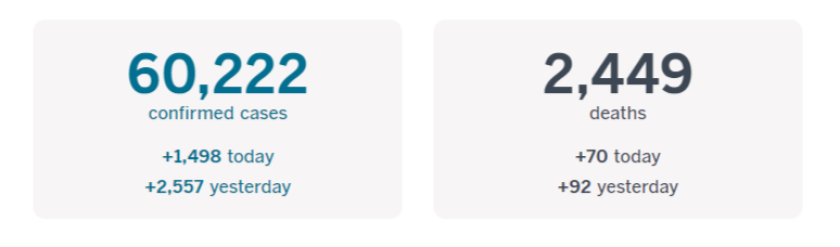
on Tuesday reported more than 2,500 new coronavirus cases, the highest
single-day statewide total since the pandemic began. The high number is
partially due to a backlog in reporting, health officials say, but it’s still
sparking widespread discussions about whether there has been enough progress in slowing
hospitalizations and deaths to begin loosening Gov. Gavin Newsom’s
stay-at-home order.
“We do know as we reopen, more people will be out and about, and we’ll
see more cases,” Los Angeles County Public Health Director Barbara Ferrer
said. “Nothing has really changed about the virus since March. The virus
didn’t get less deadly. The virus didn’t get less infectious. The virus is still out there.”
Some low-contact businesses — florists, car dealership showrooms
and various types of brick-and-mortar stores — have gotten the green light to open as soon as Friday for curbside pickup. In-store
shopping will not be permitted for now. And as multiple states continue to
relax restrictions, social distancing rules will likely stay in place for
many, with both staff and customers required to wear masks. The number of
people allowed in an establishment will have to be reduced to allow for
six-foot spacing when possible, and anything that people touch will need to
be disinfected frequently.
But can businesses even afford to open their doors under these
restrictions? Or can they figure out new ways to turn a profit? Reporters
from The Times spoke to business owners and consumer experts to find out what a reopened world will look like — and how it’ll
affect the bottom line. Retail stores might have to get creative with new
ways of shopping. Movie theater owners say they can still keep the projectors
humming with half-capacity crowds, but not if there aren’t any new movies to
screen. Restaurants already operating on slim margins may have to depend on
liquor sales. Most experts agree that businesses need a new approach for the
new normal. “Without a strategic plan, it’s not going to be profitable to
open back up,” said a retail consultant.
If the easing of restrictions brings a rise in new coronavirus cases as
expected, it’ll continue to take a toll on medical workers battling
COVID-19. Hospital administrators expect a surge of mental health ailments affecting physicians and nurses. As many as 20% to 25% of
healthcare workers in hard-hit areas, experts say, are likely to develop
disorders such as anxiety, depression or post-traumatic stress — a rate
similar to soldiers returning from combat. “The mortality that even veteran
clinicians are witnessing has been massive and devastating,” said the
psychiatry department chair at the Columbia University College of Physicians
and Surgeons.
Are you in need of mental health services? We’ve listed some resources
below in the Your Questions Answered section of this newsletter.
By the numbers
California cases and deaths as of 4 p.m. PDT Wednesday:
Track the latest numbers and how they break down in California with our graphics.
Across
California
Newsom signed an executive order Wednesday that will make it easier for
essential workers who contract COVID-19 to obtain workers’ compensation benefits.
The order presumes that infected essential workers contracted the virus
on the job, removing the burden of proof that typically falls on them and
instead requiring companies or insurers to prove they didn’t get sick at
work. “This workers comp presumption is so important, because we want people
to feel confident, comfortable, they’ll have their benefits,” Newsom said.
In one area of San Francisco’s Mission district, Latinos are testing positive for the virus at overwhelming levels,
according to a recent study. Infectious disease researchers found that those
who must leave their homes to work (roughly 57% of those tested) accounted
for 90% of the positive cases among workers, and that while Latinos made up
44% of those tested, they accounted for more than 99% of the positive cases.
The district supervisor said she would propose legislation to address the
findings by providing hotel rooms for people who test positive, replacing
wages for those who may have lost work as a result and supplying food and
other essentials to those who cannot leave home.
While Los Angeles may reopen more slowly because of its high number of
coronavirus cases, Mayor Eric Garcetti said Tuesday he supports plans to restore access to “low-risk spaces,” such as trails, in the next few
days and weeks. Newport Beach was the latest Orange County coastal city given
the go-ahead to reopen its beaches after submitting a plan to state
officials on enforcing social distancing during recreational activity.
The Los Angeles County clerk’s office hasn’t issued a marriage license
since March 16, leaving many couples wondering when they can tie the knot.
Although Newsom last week signed an order letting couples legally wed via
videoconference, L.A. County is weeks away from having such a system in
place. Several officiants and wedding chapel operators in the county
expressed frustration over the continued delay as peak wedding season
arrives, and some couples said they would rather reschedule than hold a
ceremony over videoconference. “No disrespect to those who decide to go down
this path, but a Zoom wedding is not going to satisfy anybody,” a
would-be groom said.
Resources
— For general safety, wash your hands for at least 20 seconds
(here’s a super-fun how-to video). Stop touching your face, and keep your phone clean. Practice social distancing,
maintaining a six-foot radius of personal space in
public. And wear a mask if you leave home for essential activities.
Here’s how to do it right.
— Watch for symptoms including fever, cough, shortness of breath,
chills, repeated shaking with chills, muscle pain, headache, sore throat and
loss of taste or smell. If you’re worried you
might be infected, call your doctor or urgent care clinic before
going.
— Here’s how to care for someone with COVID-19, from monitoring their symptoms to preventing the virus’ spread.
— If your job has been affected by the coronavirus pandemic, here’s how to file for unemployment.
— Here are some free resources for restaurant workers and entertainment industry professionals having trouble making
ends meet.
— Advice for helping kids navigate pandemic life includes being honest about uncertainties, acknowledging their
feelings and sticking to a routine. Here’s guidance from the Centers for Disease Control and Prevention.
Around
the nation and the world
A desperate attempt to halt the spread of the virus is underway on the Navajo
Nation, which spans portions of Arizona, New Mexico and Utah. But such
efforts have proved difficult because of the remoteness of the reservation
and the lack of electricity and running water in some homes. The crisis is
compounded by the population’s prevalence of pre-existing ailments, which
makes members more susceptible to COVID-19. “We’re vulnerable,” says
one local activist.
Despite the risks, Trump is pushing for the country to reopen, describing
citizens as “warriors” and suggesting some of them might die in the effort to
boost the economy. Asked Wednesday if the nation needs to accept greater
loss of life, Trump said “hopefully it won’t be the case, but it may very well be the
case.”
Like millions of Americans, Times congressional reporter Sarah D. Wire says her job has dramatically changed in the past month and a half.
For her and other D.C.-based reporters, walking the halls of Capitol Hill
in search of stories has given way to chasing down senators by phone and
pooling notes and audio from in-person interviews in an attempt to limit the
size of reporter scrums. Most importantly, there’s “the knowledge that there
are more stories to tell than I can possibly write.”
Your questions answered
Today’s question comes from readers who want to know: Where can I find
mental health resources? Our reporters and editors looked into some of
the options that are available.
Los Angeles County has recorded a massive uptick in calls and texts to its mental health
help line as the stay-at-home orders wear on residents, officials say. People
who have never utilized mental health services are reaching out for help to
cope with anxiety, depression, insomnia and post-traumatic stress, according
to Kathryn Barger, a county supervisor. “There is nothing wrong with asking
for help,” she said. “It is a sign of strength in an uncertain time.” County
officials are encouraging residents to utilize its mental health services by
calling (800) 854-7771 or texting “LA” to 741741.
There are also online mental health resources for students sheltering at home. For the past few weeks,
students from Burbank High School and Burroughs High School who run the Student Advisory Mental Health Board have posted videos
on YouTube and live-streamed on Instagram about various mental-health topics.
Mental health experts say simple activities like windowsill gardening and living room yoga can help reduce
stress. If you’ve been wanting to try meditation, L.A. County residents can
receive a free subscription for the mindfulness and meditation app Headspace. If you’re outside of the county, the app
offers a free 10-day introductory course that guides you through the basics
and includes access to a full library of courses spanning mindful eating,
parenting, and bedtime exercises.
Finally, here are some mental health resources for coping during the
crisis from the U.S. Centers for Disease Control and Prevention and the L.A. County Department of Public Health.
Got a question? Our reporters covering the coronavirus outbreak want to
hear from you. Email us your questions, and we’ll
do our best to answer them. You can find more answers in our Frequently Asked Questions
roundup and in our morning briefing.
For the most up-to-date coronavirus coverage from The Times, visit our live updates page
and our Health section,
and follow us on Twitter and on Instagram. |


 Posts
Posts